
Form 15g now replaced by form 121 PF withdrawal for tDS exemption
If you are withdrawing your EPF balance this year and want to stop TDS from being deducted, Form 121 is the document that stands between you and a tax cut on your own savings. This guide explains exactly how Form 121 works for provident fund withdrawals, who qualifies, what the EPFO actually checks, and the specific mistakes that cause declarations to be rejected or ignored.
Table of Contents
This process can be completed in paper form at any EPFO office or bank branch handling your withdrawal, or online if the payer institution offers that facility. As of Tax Year 2025-26, both channels are valid.
If you have already applied but stuck with in process status go through detailed guide on how to check EPF status online and offline 4 ways and fix issue if your EPF claim rejected.
What is Form 121 and How It Replaced Forms 15G and 15H for PF Withdrawal
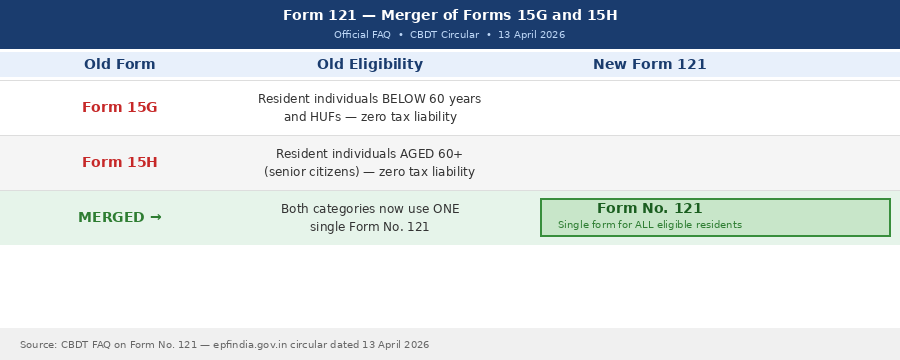
Until Tax Year 2024-25, EPF members used two separate forms to prevent TDS on provident fund withdrawals. Form 15G was for resident individuals below 60 years of age, and Form 15H was for senior citizens aged 60 and above. Both required separate eligibility conditions and separate submission procedures. Approximately 90 lakh Form 15G declarations and 1 crore Form 15H declarations were submitted across financial institutions annually during the last five years, creating significant administrative complexity.
The Income-tax Act, 2025 consolidated both into a single Form No. 121 under Section 393(6), read with Rule 211 of the Income-tax Rules, 2026. This is not simply a renamed version of the old forms. The CBDT confirmed in its circular dated 13 April 2026 that the new form has structural changes – redundant columns have been removed, explanatory notes have been added, and the form now supports auto-population of details from your tax profile, real-time validation, drop-down menus, and integration with income-tax databases. Both age groups – below 60 and 60 and above – now use one form, and both Part A and Part B of the form are standardised for all declarants.
When to Use This – Real Scenario
Ravi is 38 years old, a resident Indian, and worked with a private IT firm in Bengaluru from 2016 to 2023. He left the job and joined a startup where he opted out of EPF. His accumulated EPF balance is Rs. 4,80,000. In Tax Year 2025-26, he is drawing a salary of Rs. 2,40,000 per annum from the startup and has no other income. His estimated total income for the year – including the Rs. 4,80,000 EPF withdrawal – would be Rs. 7,20,000. After claiming the standard deduction of Rs. 75,000 and deductions under Chapter VIII totalling Rs. 1,50,000, his net taxable income falls below the exemption limit, making his estimated tax liability NIL.
Ravi submits Form 121 to the EPFO regional office handling his withdrawal before the withdrawal is processed. He fills Part A with his PAN, estimated total income including the PF amount, and his ITR acknowledgement numbers for the previous two tax years. The EPFO regional office then fills Part B, assigns a Unique Identification Number (UIN) to his declaration, and processes the withdrawal without deducting TDS. Without Form 121, EPFO would have deducted TDS at 10 percent on the withdrawal amount – a deduction of Rs. 48,000 – which Ravi would then have to claim back as a refund by filing his ITR.
Who is Eligible to Submit Form 121 for EPF TDS Exemption in 2026
The eligibility rules under Section 393(6) of the Income-tax Act, 2025 are specific and non-negotiable. Resident individuals of any age – below 60 as well as 60 and above – can submit Form 121, provided their estimated total income for the tax year will result in NIL tax liability. Hindu Undivided Families (HUFs) are also eligible. Other specified entities that are neither companies nor firms may also be eligible depending on the nature of income.
Companies and firms are explicitly excluded – no exceptions. Non-resident Indians (NRIs) cannot submit this form regardless of their income level. An individual who is a resident but not ordinarily resident must disclose that status in Field 5 but may still be eligible depending on income composition. The critical test is whether the estimated tax on total income – as calculated after all deductions under Chapter VIII and applicable rebates under Section 156 of the Income-tax Act, 2025 – comes to zero.
For declarants below 60 years, there is an additional ceiling: the aggregate income of the nature covered under Form 121 (from all payers combined during the tax year) must not exceed the basic exemption limit. This means if you are withdrawing PF from one employer and also receiving interest from a bank where you have filed another Form 121, your total across both declarations must stay within that limit. Senior citizens aged 60 and above do not face this ceiling – only the NIL tax test applies to them.
Documents Required to File Form 121 for Provident Fund Withdrawal
PAN is the single most important input. The form states clearly in Note 12 that quoting PAN is mandatory and that the declaration is invalid without it. The payer must deduct TDS at the applicable rate if PAN is absent – there is no discretion here. You do not need to attach a photocopy of your PAN card, but the number you write must match your PAN exactly as registered with the Income-tax Department.
If don’t have PAN for as per new requirement step-by-step guide to apply PAN card online free(2026) and must be linked with your adhaar.
You need the acknowledgement numbers and return income figures from your ITR filings for the two previous tax years. These go into Field 14 of Part A. If you did not file ITR in either of those years – perhaps because your income was below the filing threshold – leave the corresponding row blank and ensure your current-year income genuinely supports the NIL tax claim.
If you are 60 years or above, a document showing your date of birth may be requested by the payer for verification, since Field 5(a) of the form asks whether your age is 60 or more during the tax year. The payer records your date of birth in Field 11 of Part B.
How to Fill Part A of Form 121 for EPF Withdrawal Declaration
Before you begin download latest official Form 121 (Direct Download
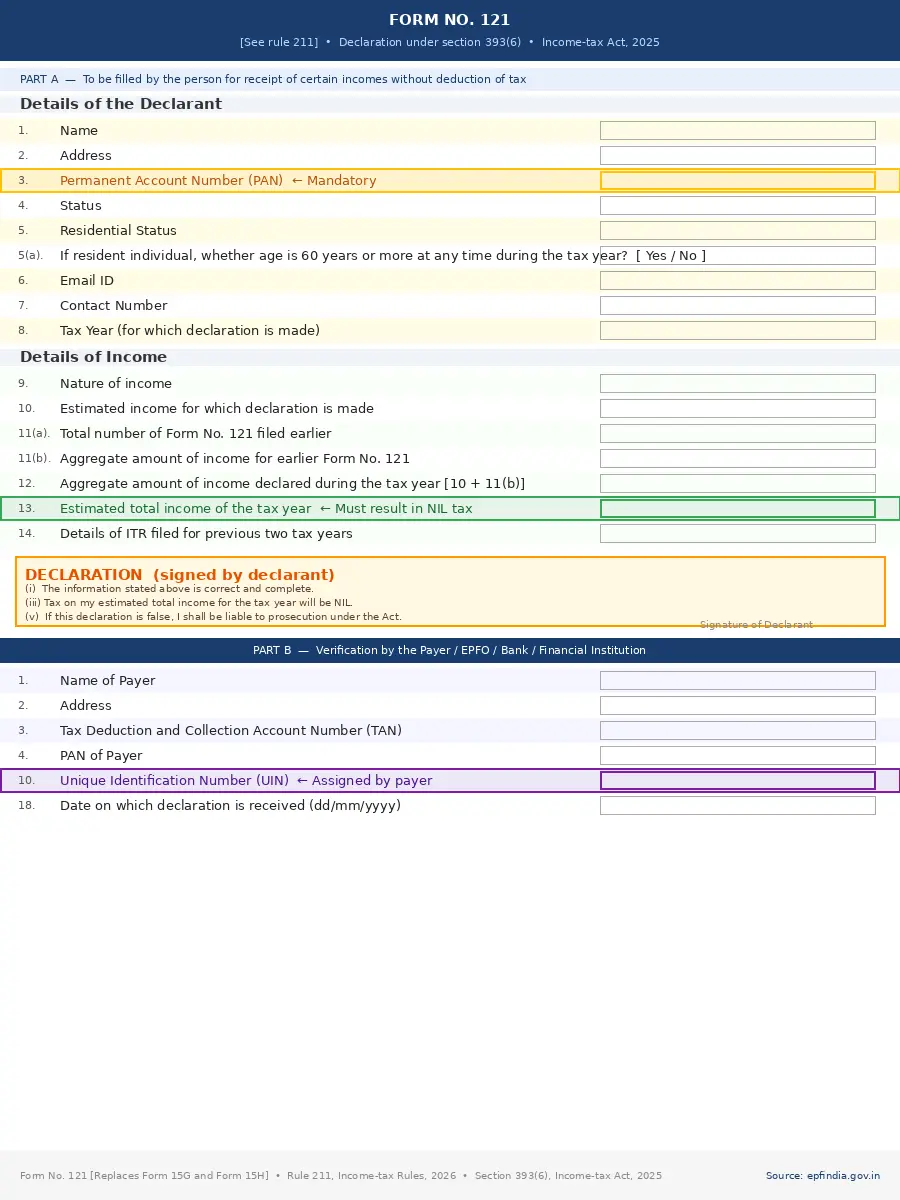
Part A belongs to you – the declarant. You fill this and sign it before handing it to the payer. Start with your full name as it appears in your PAN records, without abbreviations.
The address fields require Country, Flat or Building number, Street, PIN Code, Post Office, Area, District, and State -all eight components. A partial address is a red flag for the payer.
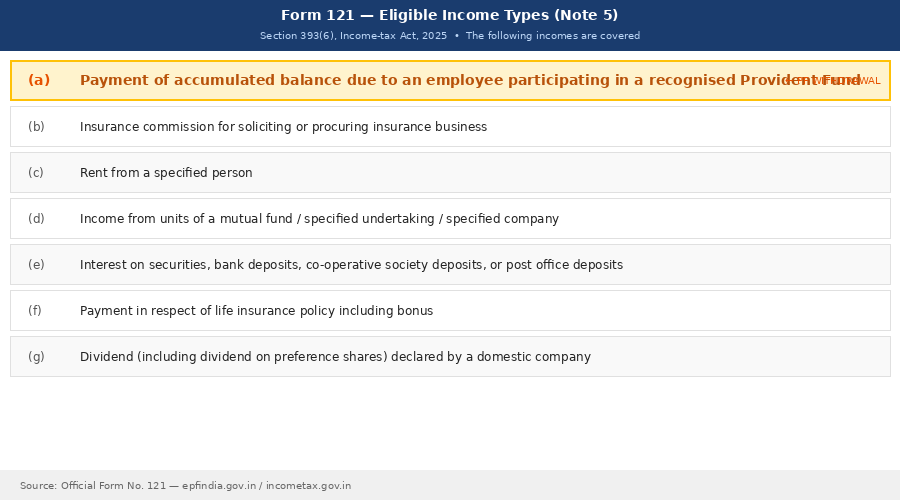
Field 9 asks for the nature of income. For PF withdrawal, this is item (a) from Note 5: “payment of accumulated balance due to an employee participating in a recognised provident fund.” Write this exactly as described – do not write “PF” or “EPF withdrawal” without the full statutory description.
Field 10 is the estimated PF amount you are withdrawing. Field 13 is the critical number – your estimated total income for the entire tax year, including all sources. This figure must include the withdrawal amount from Field 12. The payer accepts the declaration only if the tax on this number works out to NIL. Underestimating Field 13 to stay under the limit is a false declaration and attracts prosecution under Section 482.
Field 11 requires disclosure of any other Form 121 declarations you have already made to other payers during the same tax year. This is where most people make errors – they forget to mention Form 121 submissions made to their bank for FD interest earlier in the same year. The aggregate must be captured accurately.
How EPFO and Payers Process Form 121 After Submission
When you hand your completed Part A to the EPFO office or bank, the payer’s responsibility begins. Under the process defined in the CBDT circular of April 2026, the payer first checks PAN, confirms residential status, and verifies that your estimated total income – as declared in Field 13 – results in NIL tax. If your income exceeds the basic exemption limit and you are below 60, the payer cannot accept the form – they are required by law to reject it and deduct TDS.
After accepting the form, the payer fills Part B. Field 10 of Part B requires the payer to assign a Unique Identification Number to your Form 121. This UIN is structured to include a sequence number, the tax year, and the payer’s TAN. This number follows your declaration through the entire reporting chain – it is reported on the income-tax e-filing portal monthly by the payer and then quoted in the quarterly TDS return filed in Form No. 140.
The payer uploads a consolidated statement of all Form 121 declarations received each month to the Income-tax Department’s e-filing portal using their TAN login. This is separate from TDS returns. Even though no tax is deducted, the reporting obligation exists. The payer downloads the CSV utility from the portal, fills it with declaration data, attaches their digital signature, and uploads it. After processing, the portal shows the status as “Accepted” or “Rejected.” Accepted declarations are reflected in your Form 168 (Annual Information Statement) and Form AIS, linking the declaration to your PAN.
When to Submit Form 121 to Avoid TDS on EPF Withdrawal
The CBDT circular is specific: the declaration must be furnished to the payer before the scheduled transaction date. For PF withdrawals, this means before the EPFO or bank processes and credits the withdrawal amount to your account. Once TDS is deducted, the payer cannot reverse it – you must claim it back through your ITR. There is no provision for the payer to refund TDS after it has been deducted on the basis of a late or missing Form 121.
The form is valid only for the tax year for which it is made. A Form 121 submitted for Tax Year 2025-26 does not carry forward to Tax Year 2026-27. If you have a staggered PF withdrawal – for instance, partial withdrawals in consecutive years – you must submit a fresh Form 121 for each tax year separately.
Common Mistakes While Submitting Form 121 for PF Withdrawal TDS Benefit
The most damaging error is submitting a Form 121 when you are not actually eligible. If your estimated total income – once the PF withdrawal amount is added – crosses the basic exemption limit and results in a non-zero tax liability, the payer is required to reject the form. Filing it anyway is a false declaration under Section 482 of the Income-tax Act, 2025, punishable by prosecution. Many employees calculate their income excluding the PF withdrawal, realise their income is below the threshold, and submit the form – only to find out that adding the PF amount itself pushes them over the limit.
The second common failure is submitting the form without a valid PAN, or with a PAN that does not match the PAN on record with the Income-tax Department. Note 12 of the form states explicitly that the payer must deduct TDS at the applicable rate if PAN is not furnished or is incorrect. The payer has no discretion here – the law requires deduction.
The third error is not disclosing other Form 121 declarations filed with other payers during the same tax year. Fields 11(a) and 11(b) exist precisely for this. If you filed Form 121 with your bank for FD interest in April and are now filing another Form 121 with EPFO for a PF withdrawal in October, both must be aggregated. Failing to disclose the earlier declaration understates your aggregate declared income and may invalidate the current form if the total would have exceeded the applicable limit.
A fourth mistake – common among senior citizens – is assuming that Form 15H is still valid. It is not. From Tax Year 2025-26 onwards, the payer is required to use Form 121. Any submission on an old Form 15H or Form 15G format will be treated as non-compliant, and TDS will be deducted.
What Happens After You Submit Form 121 for PF Withdrawal
Once the EPFO or bank accepts your Part A declaration, the payer completes Part B and assigns a UIN. The withdrawal is then processed without TDS deduction. The payer is required to submit a monthly statement to the Income-tax Department’s e-filing portal reporting the declaration details including your PAN, the UIN, and the income amount. This happens on or before the 7th of the following month.
In the quarter when the withdrawal is paid, the payer includes your UIN in the quarterly TDS statement filed in Form No. 140. This is the mechanism by which the Income-tax Department cross-checks that no TDS was deducted for a valid reason the Form 121 declaration – rather than due to a compliance failure by the payer. If the payer omits the UIN or reports incorrectly in Form 140, they face penalties under relevant provisions of the Income-tax Act, 2025. Your declaration data is then reflected in your Form 168 (Annual Information Statement) and AIS on the income-tax e-filing portal, confirming that the declaration has been received, processed, and linked to your PAN.
You do not need to attach Form 121 to your ITR. However, the income you declared in Field 13 – your estimated total income including the PF withdrawal – should align with your actual return. If your actual income for the year turns out higher than estimated, you may owe tax on the PF withdrawal amount, and it will show up during ITR processing without any TDS credit available against it. In that case, you must pay the shortfall as self-assessment tax before filing.
Frequently Asked Questions(FAQ)
Can I submit Form 121 online for my EPF withdrawal, or does it have to be physical?
You can submit it online if the payer – your bank or EPFO regional office – offers an online facility. The CBDT circular confirms that both paper and online submission are valid. Many banks support online Form 121 submission through internet banking, but EPFO online submission availability varies by region. Confirm with your EPFO regional office before assuming online is available.
My EPF withdrawal happened partly in one tax year and partly in the next. Do I need two separate Form 121 submissions?
Yes. Form 121 is valid only for the specific tax year for which it is declared. If your withdrawal spans two tax years – for instance, partial credits in March 2026 and the balance in April 2026 – you must submit a separate Form 121 for each tax year. The income and eligibility must be recalculated independently for each year.
I already filed Form 15G with my bank this year for FD interest. Now I am also withdrawing PF. Do I need to disclose the bank declaration in my Form 121 for EPFO?
Yes – this is mandatory. Fields 11(a) and 11(b) of Part A require you to disclose all Form 121 declarations filed with other payers during the same tax year. Your earlier Form 15G with the bank has now transitioned to the Form 121 framework. The aggregate of both – FD interest and PF withdrawal – must remain within your NIL tax threshold for both declarations to be valid.
The EPFO portal shows TDS was deducted despite my Form 121 submission. What should I do?
Check whether your Form 121 declaration appears in your AIS on the Income-tax e-filing portal. If the payer did not report your UIN in their monthly statement or Form 140 return, the deduction may have gone through due to a payer-side compliance failure. Contact the EPFO regional office in writing, citing your Form 121 submission date and the UIN assigned. The TDS can then be claimed as a refund when you file your ITR for the year.
Does submitting Form 121 mean the PF withdrawal amount is tax-free?
No. Form 121 only prevents TDS at the point of payment. It does not exempt the income from tax. If your actual total income for the year after all deductions exceeds the taxable limit, you owe tax on the excess, including the PF amount, and must pay it as advance or self-assessment tax. The form is a declaration about expected NIL tax, not a certificate of exemption.
Try Our In house Rent Receipt Generate For Free – Every receipt generated is pre-built to meet Income tax Act Section 10(13A) and rule 2A(1) requirements